Forecast accuracy backtest
See what Pipemetry would have forecast — on your own closed quarters.
Don’t take the forecast on faith. The backtest replays Pipemetry’s model against quarters you’ve already closed and scores it from three vantage points — day one, halfway through, and 80% through — so you can judge the accuracy before you commit a single forward number.
14-day full-Pro trial, no card · Proof on your own history, not a demo
Proof beats a promise
Every forecasting vendor claims accuracy. The honest way to check is to run the model on the quarters you’ve already lived through and see how close it lands. Because Pipemetry keeps a point-in-time record of your pipeline, it can rebuild each past quarter exactly as it stood at day one, mid-quarter, and late — and grade the call it would have made against what actually closed. No hindsight, no leakage.
How the backtest works
-
Backtested on your data, not a demo
The backtest runs on quarters you’ve already closed — your pipeline, your deals, your outcomes — not a canned demo. It replays the same leak-free model Pipemetry uses going forward, so what you see is what it would genuinely have called.
-
Three vantage points per quarter
Each closed quarter is scored from three moments: day one (the cold open), the midpoint, and the 80% mark when the call is due. That shows how the forecast sharpens as a quarter progresses, instead of only grading the easy late call.
-
Scored against what actually closed
At each vantage the projection is compared to the closed-won total that actually landed, and summarized as a per-vantage MAPE — the same metric the ongoing accuracy scorecards use, so the backtest and live tracking speak the same language.
-
Honest when history is thin
If a quarter is before your history begins, it’s dropped — never scored as a fabricated “we’d have said zero.” A new or thin-history workspace gets an honest-empty result rather than an invented number. We’d rather show you nothing than mislead you.
-
From backtest to live tracking
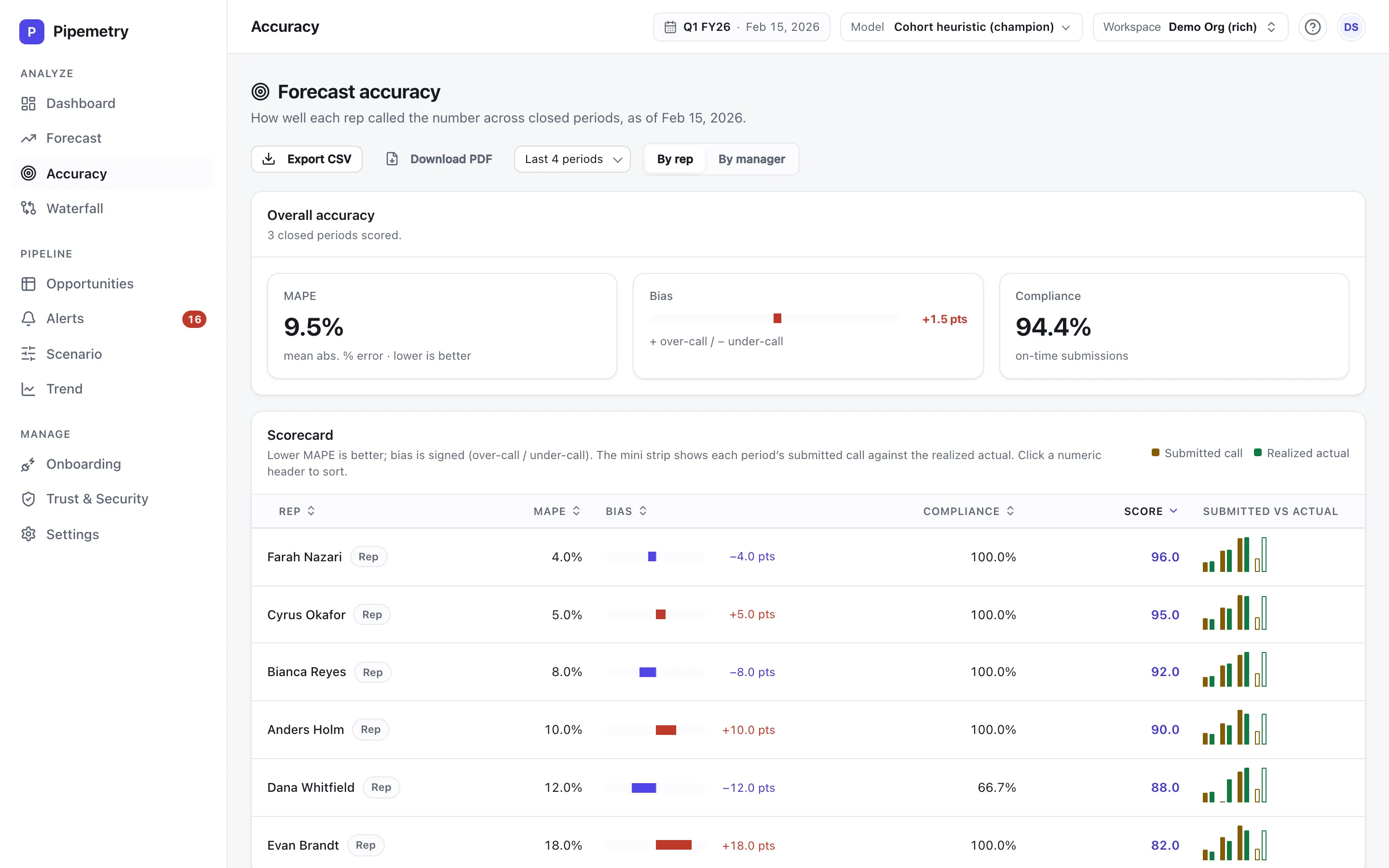
Once you trust the retrospective proof, the same MAPE and bias metrics run continuously as accuracy scorecards on every new period — so the number you rely on keeps being measured. Here’s how to measure sales forecast accuracy.
-
Understand every move
A backtest tells you how accurate the call was; the waterfall tells you why the number moved between two dates. Read why did my sales forecast change for the decomposition into risk, amount, and new-or-dropped pipeline.
Who it’s for
If you’re evaluating a forecasting tool for a 10–100 rep team and want evidence before you trust it, the backtest is the proof point. Pair it with the ongoing accuracy scorecards and, if you’re still weighing options, read how to choose revenue forecasting for a smaller team. No supported CRM yet? You can still forecast from a spreadsheet — the backtest needs closed history to score, so it fills in as your quarters close.
Backtest FAQ
What is a forecast accuracy backtest?
A backtest replays a forecasting model against periods you’ve already closed and scores what it would have predicted against what actually happened. It’s a way to judge accuracy before you commit a single forward number — proof on your own history, not a vendor’s demo.
How does Pipemetry backtest on my data?
It walks your own closed quarters and, for each one, replays the same leak-free model at three vantage points — day one, the midpoint, and the 80% mark — then compares each projection to the closed-won total that actually landed and summarizes a per-vantage MAPE.
What if we don’t have much history?
You get an honest-empty result. Quarters before your history begins are dropped rather than scored as a fabricated zero, so a new or thin-history workspace simply sees that there isn’t enough closed history yet — not an invented accuracy number.
How is accuracy measured?
With MAPE (mean absolute percentage error) at each vantage, the same metric Pipemetry’s ongoing accuracy scorecards use. That way the retrospective backtest and the continuous tracking are directly comparable.
Is the backtest the same as ongoing accuracy tracking?
They’re two sides of the same coin. The backtest is retrospective proof on quarters you’ve already closed; the accuracy scorecards then run the same MAPE and bias metrics continuously on every new period as it closes.
Judge the forecast before you trust it.
Connect your CRM, close a quarter, and backtest what Pipemetry would have called — scored against what actually happened. Start free.